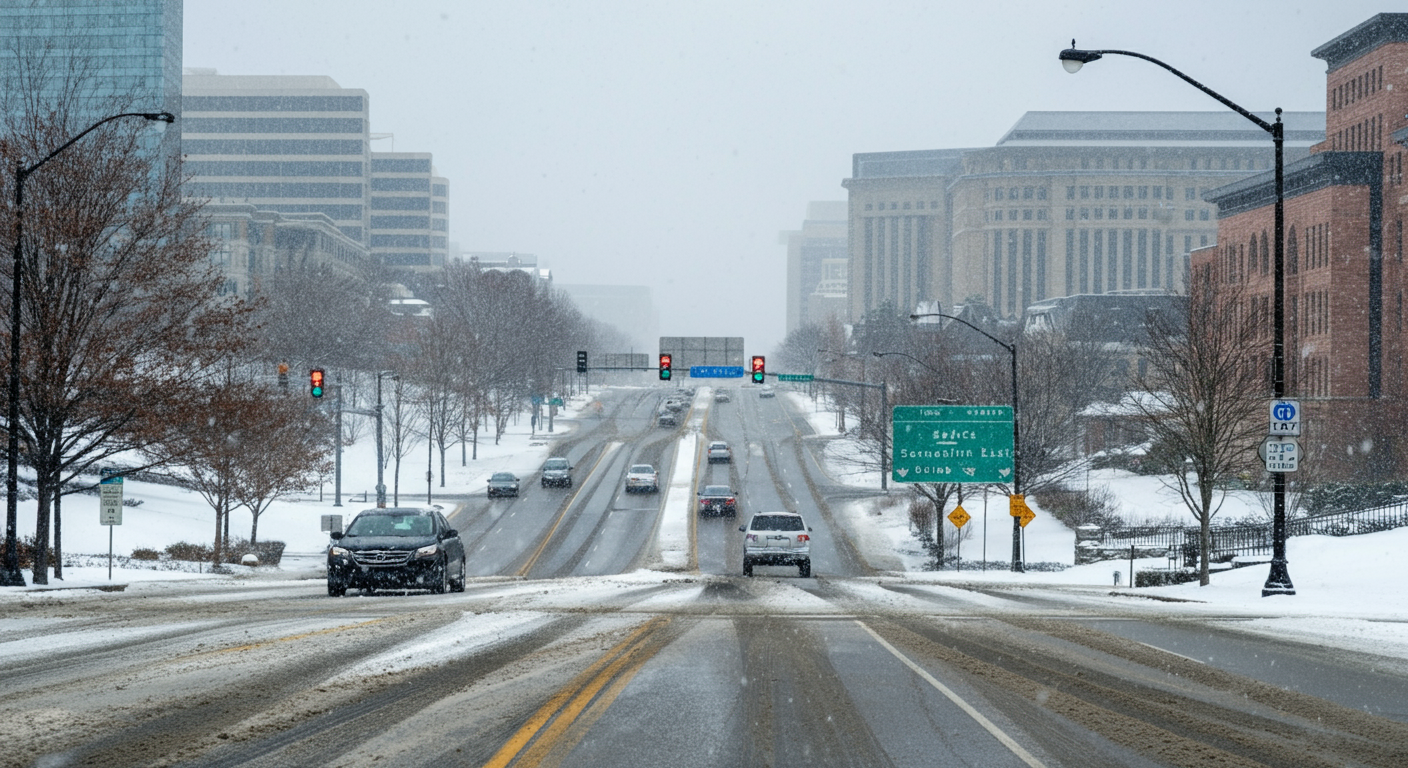
DC’s snow response is a case study in the “Fragility of the Middle.” The region sits in a meteorological transition zone where temperatures hover at the freezing point, turning minor precipitation into a high-friction slush that overwhelms standard brine treatments. The current paralysis across Alexandria, Arlington, and Fairfax—contrasted with a mere two-hour delay for DC Public Schools—exposes a deep-seated fragmentation in regional risk tolerance. This isn’t just about weather; it is a breakdown of a unified transit philosophy in a region where the workforce crosses three sets of jurisdictional lines twice daily.
The Infrastructure Gap: Why Minor Snowfall Paralyzes DC Roadways
The primary culprit in regional gridlock is not the depth of snow, but the chemical composition of the “slush” currently blanketing the DMV. Unlike the dry, powdery snow of the Midwest, DC’s moisture-heavy precipitation creates a high-viscosity layer that traps tires and renders traditional plowing inefficient. Because the region relies on a “just-in-time” treatment model, the rapid transition from rain to slush prevents brine from bonding with the asphalt. This creates a friction-less barrier that turns minor inclines into insurmountable obstacles, particularly on the secondary roads of Prince George’s County and Loudoun.
The Closure Logic: Deciphering School District Decision-Making Patterns
There is a clear divergence in how school districts weigh liability versus service continuity. The decision by Alexandria, Arlington, and Fairfax to close entirely while DCPS opts for a two-hour delay highlights a “Bus Fleet Liability” metric. Suburbs with sprawling bus routes face a geometric increase in risk compared to the walkable, metro-accessible urban core of DC. For suburban superintendents, the risk of a single bus sliding on an untreated cul-de-sac outweighs the educational loss of a single day. Conversely, DCPS’s delay suggests a priority on the social safety net—meals and childcare—that schools provide in an urban environment.
Economic Ripple Effects of Regional Weather Shutdowns
When the federal government announces a late opening, the economic hit radiates through the private sector. The “Federal Hub” effect means that if the OPM (Office of Personnel Management) flinches, the entire ecosystem of contractors, lobbyists, and service providers follows suit. While remote work has mitigated some of the total productivity loss, the “slush tax” remains high. Retail and service sectors in Northern Virginia and Maryland experience a near-total revenue freeze during these morning windows, as slushy road conditions deter all but the most essential travel.
Comparative Analysis: How DC’s Current Response Matches Historical Data
Data suggests that regional emergency management is becoming more risk-averse rather than more resilient. Historically, two inches of slush might have triggered a delay; today, it triggers a full regional shutdown. This shift is driven by the “Snowmageddon” trauma of previous decades, leading to a “preemptive surrender” strategy. Despite better real-time snow mapping and NOAA data integration, the threshold for closure has lowered, suggesting that the region has prioritized liability mitigation over infrastructure hardening.
Future-Proofing the Capital: Predictive Modeling for Winter Readiness
To move beyond the cycle of seasonal transit failure, the DMV requires a shift toward “Heated Corridor” investments and automated brine systems. Current video evidence from Prince George’s County shows that manual plowing is insufficient for the rapid-freeze cycles common in the Mid-Atlantic. Future-proofing must involve predictive AI modeling that triggers road treatments hours before the first flake falls, rather than reacting to the “slushy morning” reality that WUSA9 and other outlets are currently documenting.
Behind the Scenes
The political dimension of school closures often goes unmentioned: it is a battle of optics. Local officials fear the “viral video” of a stuck bus more than the quiet erosion of student learning hours. Furthermore, the federal government’s late-start policy is often a negotiated peace between agency heads who want productivity and unions concerned about commuter safety. This results in a “wait-and-see” approach that often leads to the worst of both worlds: a late start that still encounters the peak of the slush-freeze cycle.
Counter-Opinion
The narrative that DC “can’t handle snow” is an oversimplification. The reality is that the region’s infrastructure is optimized for heat and humidity, not ice. Investing hundreds of millions in a massive snow-removal fleet that sits idle for 340 days a year is fiscally irresponsible. The current “shutdown” strategy, while frustrating, is actually a rational economic choice when compared to the cost of maintaining a Montreal-level winter response team in a swamp-climate zone.
Bold Prediction
Within the next six months, expect a push for a “Regional Weather Compact” among DMV superintendents to synchronize closure decisions. The current patchwork of delays and closures creates a child-care nightmare for the thousands of parents who live in one jurisdiction and work in another. By next winter, “Distance Learning” will likely replace “Snow Days” entirely in Fairfax and Montgomery counties, ending the era of the true “day off” as districts seek to protect their state-mandated instructional hours from the unpredictability of the Mid-Atlantic climate.
Frequently Asked Questions
Why does the DC region often close for relatively small amounts of snow?
We find that the region’s high traffic density and complex commuter patterns make even minor accumulations a significant safety risk. Additionally, the limited number of heavy-duty plows compared to northern cities necessitates a more cautious approach to prevent gridlock.
How does OPM determine whether to close federal offices?
We analyze how the Office of Personnel Management coordinates with local meteorologists and transit authorities like WMATA to assess road safety and rail availability. Their decisions prioritize the safety of over 300,000 federal employees while ensuring essential government functions remain operational.
Why do residential streets take longer to clear than major highways?
We observe that regional response plans prioritize “snow emergency routes” to ensure that emergency vehicles and public transit can move through the city. Residential plowing typically begins only after these primary arteries are cleared and deemed safe for high-volume traffic.
Have snow closures become more frequent in the DC area recently?
Our data suggests that while total snowfall varies annually, the frequency of “preemptive” closures has increased as a risk-management strategy. We see a growing trend where jurisdictions prefer early closures to avoid the logistical dangers of midday dismissals during active storms.
Why do closure decisions vary between DC, Maryland, and Virginia?
We note that each jurisdiction manages its own resources and faces unique geographic challenges, such as the hilly terrain in Northern Virginia versus the flatter areas of DC. These differing environmental factors and local infrastructure capacities often lead to staggered closure announcements across the DMV.
Conclusion
We believe that the DC area’s response to snow events demonstrates a prioritized focus on public safety through proactive school closures and federal government delays. While these measures are often met with debate, we conclude that the efficiency of regional coordination effectively mitigates the risks associated with slushy roads and unpredictable accumulation totals.
References
- Live updates: Roads slick, schools delayed as snow hits DC area — Real-time reporting on regional closures and road conditions during snow events.
- Schools closed or delayed, roads slushy after snow blankets DC area — Social media updates regarding federal government and school status changes.
- Waking up to slushy snow Monday morning that has led to some… — Coverage of early morning slush and resulting school delays across the region.
- See snowy road conditions in Prince George’s County — Visual evidence of road conditions impacting the Maryland suburbs.
- Map: How much snow has fallen in your area? — Data visualization of snow accumulation across the DC metropolitan region.
Report Inaccuracy
We value accuracy. If you find any inaccurate information, please let us know.