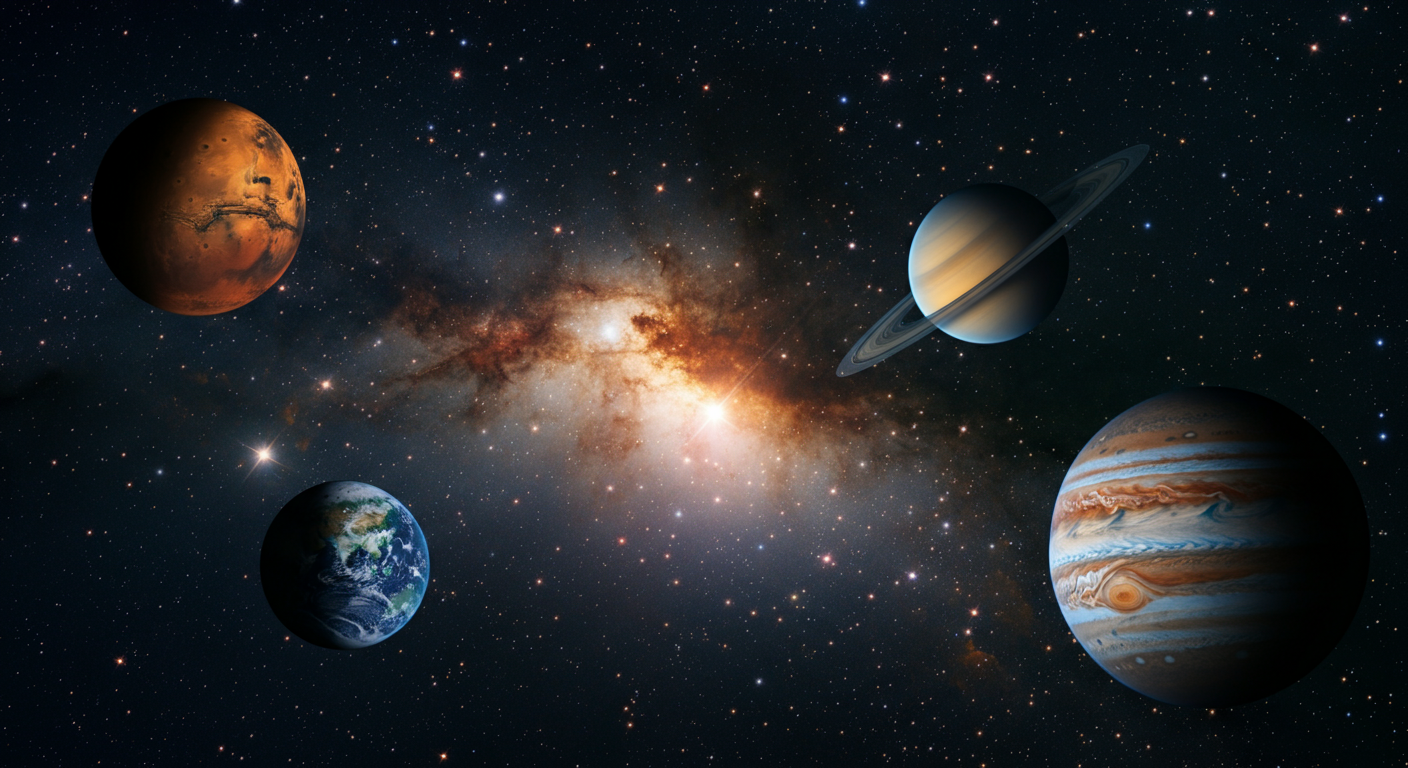
February’s planetary parade is a psychological anchor in an era of digital fragmentation, proving that celestial mechanics now function as a primary driver for global synchronized attention. While the physical alignment of planets like Mars, Jupiter, and Saturn is a predictable result of orbital resonance, the real phenomenon lies in the “Algorithm of Awe”—where rare physical events are leveraged to create massive spikes in non-commercial digital engagement. This isn’t just astronomy; it is a demonstration of how predictable physical laws can still command a monopoly over the modern attention economy.
1. The Mechanics of Syzygy: Understanding the Geometry of Alignment
The term “alignment” is technically a misnomer that masks a complex three-dimensional dance. True syzygy—a straight-line configuration of three or more celestial bodies—is rare. What we witness in February is a sectoral clustering. The planets are not “lined up” in space; rather, their relative positions along the ecliptic plane converge within a narrow visual arc from our terrestrial vantage point. This synchronization is driven by the varying orbital velocities: inner planets act as the fast-moving hands of a clock, while outer giants provide the stationary backdrop. The gravitational influence of these alignments on Earth is negligible, yet the geometric precision offers a rare moment where the chaotic nature of the universe appears ordered and intentional.
2. Visibility Dynamics: Evaluating February’s Optimal Observation Windows
Visibility is dictated by the “Seeing” factor—an astronomical metric of atmospheric stability. February provides a unique advantage: cold, dry air holds less moisture, reducing the scintillation (twinkling) that blurs planetary disks. To capture the full sequence, observers must exploit the “Golden Window” shortly before dawn. The technical challenge lies in the varying magnitudes; while Venus dominates at -4.6, the dimmer presence of Mars requires high-contrast environments. The success of this observation window depends less on telescope power and more on the absence of light pollution, making “Dark Sky” locations the premium real estate of the month.
3. The Attention Economy: Why Celestial Events Drive Viral Engagement
Celestial events are the ultimate “low-friction” viral content. Unlike political or economic news, a planetary parade is universally accessible and politically neutral, providing a rare “safe harbor” for social media platforms. We are seeing a transition from passive observation to active participation. The viral nature of these events is fueled by the “scarcity heuristic”—the psychological drive to witness something that won’t recur in the same pattern for years. This creates a massive, temporary surge in search traffic that outpaces traditional news cycles, as users seek a sense of collective experience in an increasingly isolated digital landscape.
4. Trend Radar Analysis: The Societal Shift Toward Experiential Science
The democratization of the sky is no longer a fringe hobby. We are witnessing the rise of “Experiential Science,” where the barrier to entry has been demolished by hardware-software integration. Mobile tracking apps like Stellarium and AR-enabled sky maps have transformed the smartphone from a distraction into a scientific instrument. This shift represents a broader societal move toward “Verified Reality”—a desire to see and confirm physical phenomena personally rather than consuming them through a screen. The surge in sales for smart telescopes (Dwarf II, Seestar) confirms that consumers are willing to invest heavily in tools that bridge the gap between amateur curiosity and professional-grade astrophotography.
5. Future Projections: Long-term Cycles of Major Planetary Groupings
Looking ahead, the frequency of these clusters will fluctuate as Saturn and Neptune move further apart in their respective orbits. However, the next 24 months will see a peak in “lunar-planetary occultations,” where the moon passes directly in front of these aligned planets. This will drive a secondary market for high-speed photography equipment. Scientifically, these alignments remain critical for gravity-assist trajectory planning for deep-space probes, but for the public, they will increasingly serve as “Digital Sabbaths”—scheduled periods where global interest shifts from the micro-trends of Earth to the macro-cycles of the solar system.
Behind the Scenes
The economic dimension of the planetary parade is often overlooked. Beyond the “helth” benefits of reduced blue-light exposure and nature-based “forest bathing,” there is a booming “Astrotourism” economy. Rural regions with low light pollution are now marketing these alignment windows as premium travel dates, rivaling traditional seasonal holidays. Economically, we are seeing a shift where “Darkness” is becoming a luxury commodity, sold through high-end observatories and remote eco-lodges.
Counter-Opinion
The “Planetary Parade” is frequently over-hyped by digital media outlets that use artistic renderings rather than actual photographs. For the average urban viewer, light pollution often renders 60% of the “parade” invisible to the naked eye. There is a growing gap between the “Instagrammable” expectation of a perfect line of glowing orbs and the reality of faint dots on a hazy horizon. This “expectation gap” risks devaluing actual scientific literacy in favor of aesthetic consumption.
Bold Prediction
Within the next six months, “Dark Sky Compliance” will become a major selling point in luxury real estate and municipal planning. As the planetary parade trend continues to grow, cities that implement “Smart Lighting” (reducing upward light spill) will see a measurable increase in tourism revenue and property values, turning astronomical visibility into a quantifiable economic asset.
Frequently Asked Questions
What is the best time of day to view the February planetary parade?
We recommend looking toward the horizon roughly 30 to 60 minutes before sunrise for the clearest view. During this window, the planets are high enough to be seen but the sky is still dark enough to provide necessary contrast.
Do I need a telescope or binoculars to see the alignment?
Most of the planets in this parade are visible to the naked eye, so specialized equipment isn’t strictly necessary. However, we suggest using binoculars if you are in an area with light pollution or if you want to see the distinct colors of planets like Mars or Saturn.
How rare is this specific celestial alignment trend?
While small groupings of two or three planets are common, a “parade” of five or more planets is much rarer. We typically only see these significant alignments every few years, though the specific configuration of planets changes every time.
Does a planetary parade have any physical effect on Earth?
We can confirm that planetary alignments do not cause any significant gravitational or physical changes on Earth. The distance between the planets is so vast that their combined pull is negligible compared to the influence of the Moon and the Sun.
Which direction should I face to see the planets this February?
For this particular event, we advise observers to face the east-southeast horizon. The planets will appear to follow the ecliptic—the imaginary line across the sky that the sun follows—stretching upward from the point of the sunrise.
Conclusion
We believe that the February planetary parade serves as a remarkable reminder of the dynamic nature of our solar system and the beauty of celestial mechanics. By observing these alignments, we can gain a deeper appreciation for the orbital paths of our neighboring planets and the rare visual spectacles they provide for stargazers worldwide.
References
- Space.com — A detailed guide on the planetary alignment featuring Venus, Mars, and Saturn in February 2024.
- EarthSky — An essential resource for identifying which planets are currently visible in the night sky.
- Star Walk — An educational overview explaining the scientific definition and different types of planetary parades.
- Sky at Night Magazine — A comprehensive resource on the mechanics and observation techniques for planetary alignments.
- In-The-Sky.org — Specific astronomical data and news regarding celestial events occurring during the month of February.
Report Inaccuracy
We value accuracy. If you find any inaccurate information, please let us know.