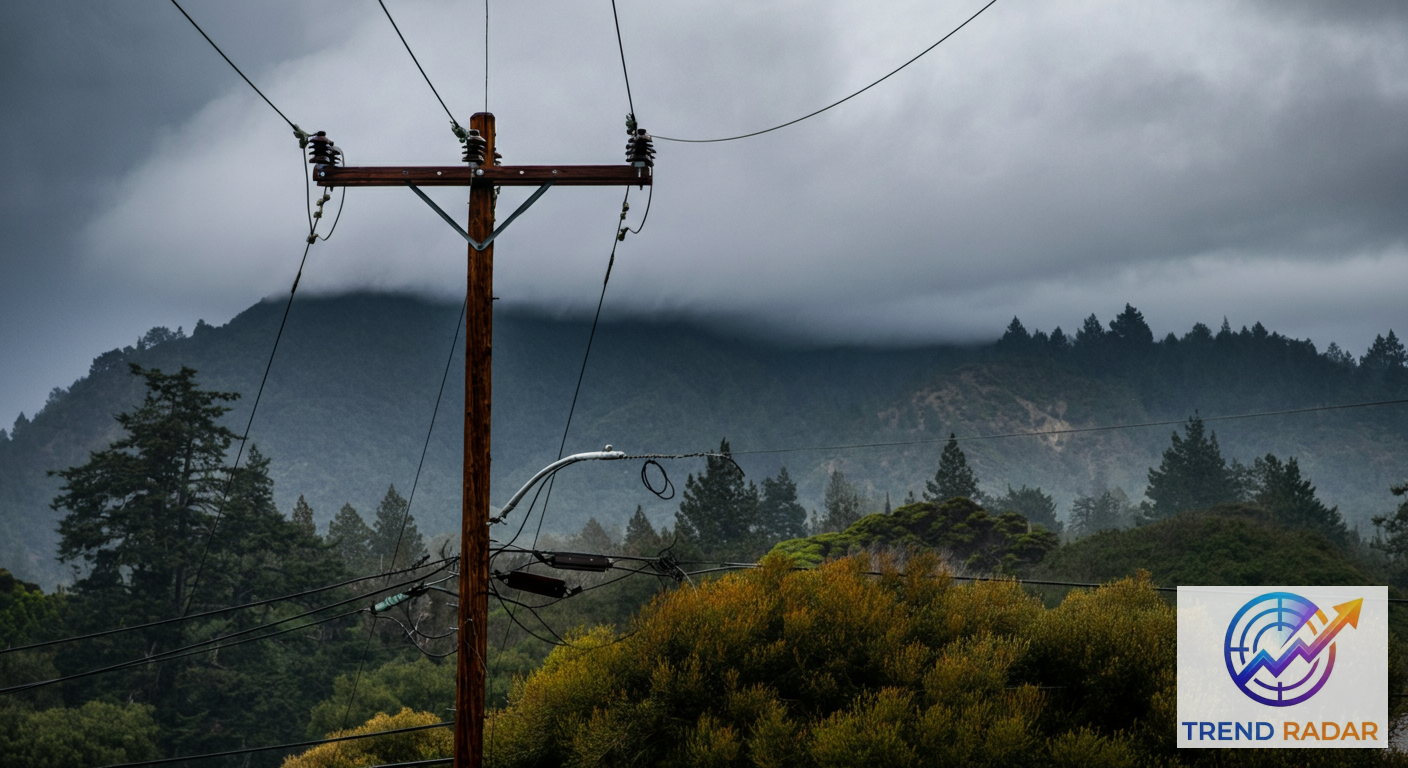
Northern California’s persistent power outages during storm cycles result from a lethal combination of rapid climate shifts, overgrown vegetation in the Wildland-Urban Interface (WUI), and a grid designed for a 20th-century environment that no longer exists. Reliability remains elusive because the physical infrastructure cannot keep pace with the increasing frequency of atmospheric rivers and extreme wind events that destabilize saturated soils and aged equipment.
Mapping the Surge: A Geographic Breakdown of Recent Outage Patterns
The geography of Northern California dictates its vulnerability. Unlike the flat, predictable plains of the Midwest, NorCal features a jagged topography that creates microclimates and wind funnels. Recent outage patterns show a distinct concentration in the Sierra Foothills and the Santa Cruz Mountains. These regions act as the front lines for atmospheric rivers—long, narrow regions in the atmosphere that transport water vapor from the tropics. When these moisture plumes hit the coastal ranges and the Sierra Nevada, they drop massive amounts of precipitation, often accompanied by high-velocity gusts.
The specific environmental trigger driving current service interruptions is the “saturated soil” phenomenon. In regions like Sonoma and Mendocino counties, heavy rainfall precedes peak wind events. The soil loses its structural integrity, allowing even healthy, non-diseased trees to uproot entirely. These trees, often located outside the standard utility right-of-way, fall onto high-voltage transmission lines. This creates a geographic “trap” where the very natural beauty that draws residents to these areas becomes the primary threat to their utility reliability.
The Wildland-Urban Interface (WUI) Trap
The expansion of residential developments into the WUI has complicated grid maintenance exponentially. In counties like Nevada and Placer, power lines must snake through dense forests to reach isolated pockets of homes. This creates thousands of miles of “radial” lines—single paths of electricity that lack the redundancy of urban networked grids. When a single tree falls in a remote canyon, it doesn’t just cut power to one house; it de-energizes the entire string, leaving thousands in the dark. Mapping these outages reveals that the hardest-hit areas are almost always those where the density of the forest meets the sprawl of suburban development.
The Atmospheric River Corridor
Recent data indicates that the “Bay Area Gap”—the region where the Pacific air flows into the Central Valley—serves as a high-speed corridor for storm energy. This corridor puts immense physical pressure on the infrastructure in the East Bay hills and the Delta. The wind speeds here frequently exceed the design tolerances of older wood-pole structures. According to the National Weather Service, the frequency of these high-intensity moisture events is increasing, meaning the geographic zones of “high risk” are expanding further into what were previously considered “moderate” weather zones.
Structural Vulnerabilities: Why Northern California’s Grid Remains Fragile
The fragility of Northern California’s grid is not a mystery of engineering; it is a consequence of legacy hardware facing modern stressors. Much of the regional distribution system relies on wood poles and uninsulated “bare” wires. These components were installed decades ago under the assumption of a more stable climate. Today, they face “cascading failures.” When one pole snaps due to wind or a fallen limb, the tension on the line often pulls down several adjacent poles, turning a localized repair into a multi-day reconstruction project.
The inherent challenge of maintaining power lines in high-risk terrain is the lack of accessibility. In the North Bay and the Emerald Triangle, utility crews often face mudslides and washed-out roads when attempting to reach a fault. This physical barrier extends the duration of outages far beyond what would be expected in a metropolitan setting. Furthermore, the sheer scale of the network—spanning tens of thousands of miles—makes comprehensive “vegetation management” an almost impossible task. Even with aggressive pruning, the “fall-in” zone for a 100-foot Douglas fir is far larger than any standard utility easement.
The Radial Line Weakness
Most of NorCal’s rural grid is built on a radial architecture. In a networked grid, if one path is blocked, electricity can be rerouted through another. In a radial system, there is only one path. This structural choice was made for cost-efficiency during the mid-20th century expansion. Now, it serves as a massive vulnerability. To fix this, utilities would need to build “loops” or redundant paths, a task that is both prohibitively expensive and legally complex due to land-use rights. The Federal Energy Regulatory Commission has highlighted the need for increased transmission redundancy, but the implementation in rugged terrain remains a logistical nightmare.
Legacy Hardware vs. Modern Load
Beyond the poles and wires, the transformers and substations themselves are aging. Older transformers are less resilient to the “surges” that occur when lines are struck by debris. When a storm hits, the sudden fluctuations in voltage can fry older sensitive components that lack modern surge protection. This necessitates the replacement of entire units, which are currently subject to global supply chain delays. The Department of Energy has noted that the average age of a transformer in the U.S. is nearly 40 years, and Northern California is no exception to this trend of geriatric infrastructure.
“The convergence of extreme weather and aging infrastructure has created a ‘new normal’ where traditional maintenance cycles are no longer sufficient to guarantee grid uptime.”
Behind the Numbers: Quantifying the Economic Impact of Mass Blackouts
The economic toll of Northern California’s outages extends far beyond the utility’s repair bill. When the lights go out for 48 to 72 hours, the local economy suffers a “triple hit”: lost perishable inventory, lost productivity, and the secondary costs of emergency response. For small businesses in rural hubs like Grass Valley or Eureka, a three-day outage can represent the difference between a profitable quarter and a net loss. Restaurants lose thousands in refrigerated stock, and manufacturing facilities face “restart costs” that can exceed the value of the lost time itself.
Indirect costs are even more insidious. Supply chain friction increases as logistics hubs in the Central Valley lose power, delaying the movement of goods across the state. Furthermore, the “Public Safety Power Shutoff” (PSPS) protocols—while necessary to prevent wildfires—create a predictable but painful economic drag. Businesses must invest in expensive backup generators or battery storage systems, effectively paying a “reliability tax” just to keep their doors open. The California Public Utilities Commission continues to audit the balance between safety-driven shutoffs and the economic necessity of continuous power.
Commercial Stagnation and Opportunity Cost
The uncertainty of the grid also deters investment. Tech firms and heavy industry are less likely to expand into regions where power reliability is questionable. This leads to a long-term “opportunity cost” for Northern California counties. If a data center or a cold-storage facility cannot guarantee 99.9% uptime, they will look toward the more stable—albeit more expensive—urban centers or move out of state entirely. This migration of industry erodes the local tax base, leaving even fewer resources for local infrastructure improvements.
The Cost Comparison of Grid Failures
To understand the scale of the problem, one must look at the disparity between the cost of prevention and the cost of failure. While grid hardening is expensive, the cumulative economic loss of frequent outages is staggering.
Future-Proofing the Power Supply: Strategic Shifts in Utility Resilience
The path forward requires a move away from the “patch and repair” model toward a “harden and decentralize” strategy. Grid hardening is the most immediate solution. This involves replacing wood poles with steel or composite materials that can withstand 100+ mph winds and installing “covered conductors”—insulated wires that do not spark when hit by a branch. These upgrades are currently being deployed across high-fire-threat districts, but the pace of installation is often criticized by residents and regulators alike.
However, the ultimate “future-proof” solution is undergrounding. By burying power lines, utilities can virtually eliminate the risk of wind and vegetation-related outages. The primary hurdle is the cost, which can be ten times higher than overhead lines. Despite this, major utilities in California have committed to burying thousands of miles of lines over the next decade. This is a generational shift in how we view utility infrastructure—moving from the cheapest possible delivery system to the most resilient one. The Energy Information Administration monitors these capital expenditures as they directly influence future rate hikes for consumers.
Microgrids as Local Fortresses
While undergrounding takes decades, microgrids offer a more immediate form of resilience. A microgrid is a localized group of electricity sources and loads that normally operates connected to and synchronous with the traditional wide-area synchronous grid, but can also disconnect to function autonomously in “island mode.” For a town like St. Helena or Weaverville, a microgrid powered by solar and large-scale battery storage can keep essential services running even when the main transmission lines are severed. This decentralization reduces the “all or nothing” nature of the current grid.
The Role of Distributed Energy Resources (DERs)
The integration of home batteries and electric vehicles (EVs) into the grid—known as “Vehicle-to-Grid” (V2G) technology—could also play a role in future-proofing. If thousands of homes in a storm-prone area have their own storage, the “peak load” during a storm recovery can be managed more effectively. The Cal Fire risk maps are now being used by utilities to prioritize where these DERs should be incentivized. By turning every home into a potential “power plant,” the region can build a layer of resilience that no single atmospheric river can fully dismantle. The transition is slow, but the shift from a centralized, fragile network to a distributed, hardened system is the only viable path for Northern California’s survival in a changing climate.
Frequently Asked Questions
Why does the power go out so frequently in Northern California compared to other regions?
We face a unique combination of dense vegetation, rugged mountainous terrain, and aging infrastructure that is highly susceptible to high winds and heavy snow. These environmental factors, combined with a vast network of overhead lines, make our regional grid particularly vulnerable during the winter storm season.
Why can’t utilities simply move all power lines underground to prevent storm damage?
While undergrounding is effective, it costs significantly more than overhead maintenance and presents major engineering challenges in NorCal’s rocky or forested terrain. We are currently prioritizing undergrounding in high-risk fire zones, but the sheer scale and expense make a total transition a multi-decade project.
How does vegetation management impact the frequency of outages during storms?
We have identified that falling trees and limbs are the leading cause of storm-related outages, often occurring from trees outside the standard clearance zones. We are shifting toward more aggressive “hazard tree” removal to prevent these external strikes from taking down lines during periods of heavy soil saturation.
Why does it often take several days to restore power after a major storm passes?
We often deal with restricted access due to mudslides, fallen trees, or snow-blocked roads, which prevents our crews from reaching damaged equipment safely. Additionally, many rural NorCal circuits are “radial,” meaning a single break can cut power to thousands, requiring sequential repairs before the entire line can be re-energized.
What specific grid upgrades are being implemented to reduce these persistent outages?
We are deploying “self-healing” grid technology, such as automated reclosers, which can isolate faults and reroute power to unaffected areas within seconds. We are also hardening the system by replacing wooden poles with steel and installing covered conductors to prevent outages when lines contact debris.
Conclusion
We believe that the persistent outages in Northern California are a direct result of an aging infrastructure struggling to keep pace with increasingly severe weather patterns. To ensure long-term reliability, we advocate for a more aggressive transition toward undergrounding power lines and implementing localized microgrids across the region.
References
- PG&E Wildfire Mitigation Plan — Detailed strategies for grid hardening and safety improvements in high-risk areas.
- CPUC Electric Reliability Reporting — Official state data on utility performance and outage frequency metrics.
- U.S. Energy Information Administration — Analysis of California’s energy profile, including grid challenges and generation sources.
- Office of Governor Gavin Newsom — Official statements regarding state response to severe storm impacts on infrastructure.
Report Inaccuracy
We value accuracy. If you find any inaccurate information, please let us know.
